Data Contract#
Overview#
As described briefly in the Dash Platform Protocol explanation, Dash Platform uses data contracts to define the schema (structure) of data it stores. Therefore, an application must first register a data contract before using the platform to store its data. Then, when the application attempts to store or change data, the request will only succeed if the new data matches the data contract’s schema.
The first two data contracts are the DashPay wallet and Dash Platform Name Service (DPNS). The concept of the social, username-based DashPay wallet served as the catalyst for development of the platform, with DPNS providing the mechanism to support usernames.
Details#
Ownership#
Data contracts are owned by the identity that registers them. Each identity may be used to create multiple data contracts and data contract updates can only be made by the identity that owns the contract.
Structure#
Each data contract must define several fields. When using the reference implementation of the Dash Platform Protocol, some of these fields are automatically set to a default value and do not have to be explicitly provided. These include:
The platform protocol schema it uses
A contract ID (generated from a hash of the data contract’s owner identity plus some entropy)
One or more documents
Optional tokens with their own configuration, distribution, and authorization rules
Optional groups (sets of identities with assigned power) used to jointly authorize privileged contract actions such as token minting, burning, or configuration changes
Optional keywords used to surface the contract through discovery features, plus an optional contract description
For a practical example, see the DashPay contract.
Registration#
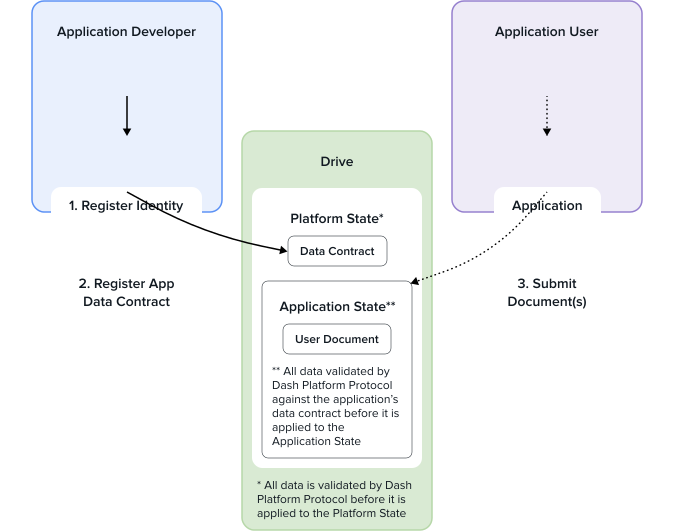
Once a Dash Platform Protocol compliant data contract has been defined, it may be registered on the platform. Registration is completed by submitting a state transition containing the data contract to DAPI.
The drawing below illustrates the steps an application developer follows to complete registration.
Data Contract Registration#
Updates#
Existing data contracts can be updated by their owner in backwards-compatible ways. Updates are applied by submitting a data contract update state transition and are validated to preserve compatibility with previously stored documents.
Permitted changes include:
Adding new document types
Adding new optional properties to existing document types
Adding non-unique indices on newly added document types
Adding new tokens to the contract
Adding new groups to the contract
Updating contract keywords and description
Restricted changes include modifications that would break existing stored documents - for example, removing or renaming existing properties, changing their types, or altering the index definitions of an existing document type. Whether a document type records the history of its transfers, sales, and price changes is also fixed when the document type is created and cannot be turned on or off by a later contract update.
A contract update cannot remove or modify an existing token or group. Changing an existing token’s configuration is done with a token configuration update transition, governed by that token’s own change control rules, and existing groups are immutable once the contract is registered.
Optional contract revision history storage allows contracts to retain a record of their revisions that can be retrieved and verified. Identity key access rules also allow an encryption or decryption key to be bound to a specific contract or document type for more granular key management.
Note
For more detailed information, see the Platform Protocol Reference - Data Contract page.
Example Contract#
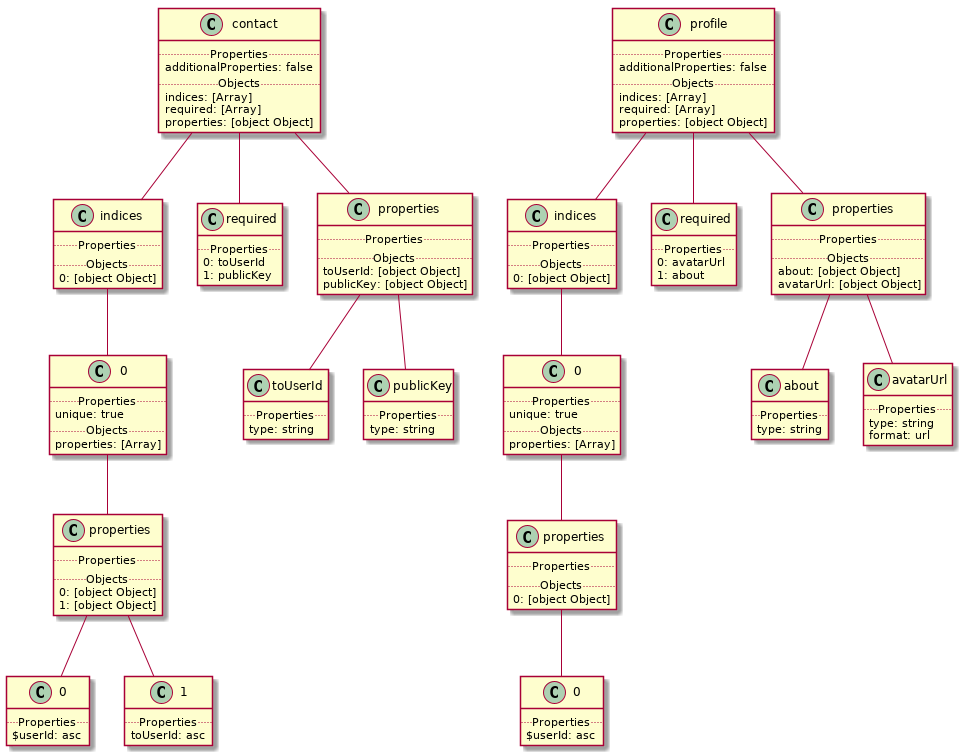
The DashPay contract is included below for reference. It defines a contactRequest document, a profile document, and a contactInfo document. Each of these documents then defines the properties and indices they require:
DashPay contract
{
  "profile": {
    "type": "object",
    "indices": [
      {
        "name": "ownerId",
        "properties": [
          {
            "$ownerId": "asc"
          }
        ],
        "unique": true
      },
      {
        "name": "ownerIdAndUpdatedAt",
        "properties": [
          {
            "$ownerId": "asc"
          },
          {
            "$updatedAt": "asc"
          }
        ]
      }
    ],
    "properties": {
      "avatarUrl": {
        "type": "string",
        "format": "uri",
        "minLength": 1,
        "maxLength": 2048,
        "position": 0
      },
      "avatarHash": {
        "type": "array",
        "byteArray": true,
        "minItems": 32,
        "maxItems": 32,
        "description": "SHA256 hash of the bytes of the image specified by avatarUrl",
        "position": 1
      },
      "avatarFingerprint": {
        "type": "array",
        "byteArray": true,
        "minItems": 8,
        "maxItems": 8,
        "description": "dHash the image specified by avatarUrl",
        "position": 2
      },
      "publicMessage": {
        "type": "string",
        "minLength": 1,
        "maxLength": 140,
        "position": 3
      },
      "displayName": {
        "type": "string",
        "minLength": 1,
        "maxLength": 25,
        "position": 4
      }
    },
    "minProperties": 1,
    "dependentRequired": {
      "avatarUrl": ["avatarHash", "avatarFingerprint"],
      "avatarHash": ["avatarUrl", "avatarFingerprint"],
      "avatarFingerprint": ["avatarUrl", "avatarHash"]
    },
    "required": [
      "$createdAt",
      "$updatedAt"
    ],
    "additionalProperties": false
  },
  "contactInfo": {
    "type": "object",
    "indices": [
      {
        "name": "ownerIdAndKeys",
        "properties": [
          {
            "$ownerId": "asc"
          },
          {
            "rootEncryptionKeyIndex": "asc"
          },
          {
            "derivationEncryptionKeyIndex": "asc"
          }
        ],
        "unique": true
      },
      {
        "name": "ownerIdAndUpdatedAt",
        "properties": [
          {
            "$ownerId": "asc"
          },
          {
            "$updatedAt": "asc"
          }
        ]
      }
    ],
    "properties": {
      "encToUserId": {
        "type": "array",
        "byteArray": true,
        "minItems": 32,
        "maxItems": 32,
        "position": 0
      },
      "rootEncryptionKeyIndex": {
        "type": "integer",
        "minimum": 0,
        "position": 1
      },
      "derivationEncryptionKeyIndex": {
        "type": "integer",
        "minimum": 0,
        "position": 2
      },
      "privateData": {
        "type": "array",
        "byteArray": true,
        "minItems": 48,
        "maxItems": 2048,
        "position": 3,
        "description": "This is the encrypted values of aliasName + note + displayHidden encoded as an array in cbor"
      }
    },
    "required": [
      "$createdAt",
      "$updatedAt",
      "encToUserId",
      "privateData",
      "rootEncryptionKeyIndex",
      "derivationEncryptionKeyIndex"
    ],
    "additionalProperties": false
  },
  "contactRequest": {
    "documentsMutable": false,
    "canBeDeleted": false,
    "requiresIdentityEncryptionBoundedKey": 2,
    "requiresIdentityDecryptionBoundedKey": 2,
    "type": "object",
    "indices": [
      {
        "name": "ownerIdUserIdAndAccountRef",
        "properties": [
          {
            "$ownerId": "asc"
          },
          {
            "toUserId": "asc"
          },
          {
            "accountReference": "asc"
          }
        ],
        "unique": true
      },
      {
        "name": "ownerIdUserId",
        "properties": [
          {
            "$ownerId": "asc"
          },
          {
            "toUserId": "asc"
          }
        ]
      },
      {
        "name": "userIdCreatedAt",
        "properties": [
          {
            "toUserId": "asc"
          },
          {
            "$createdAt": "asc"
          }
        ]
      },
      {
        "name": "ownerIdCreatedAt",
        "properties": [
          {
            "$ownerId": "asc"
          },
          {
            "$createdAt": "asc"
          }
        ]
      }
    ],
    "properties": {
      "toUserId": {
        "type": "array",
        "byteArray": true,
        "minItems": 32,
        "maxItems": 32,
        "position": 0,
        "contentMediaType": "application/x.dash.dpp.identifier"
      },
      "encryptedPublicKey": {
        "type": "array",
        "byteArray": true,
        "minItems": 96,
        "maxItems": 96,
        "position": 1
      },
      "senderKeyIndex": {
        "type": "integer",
        "minimum": 0,
        "position": 2
      },
      "recipientKeyIndex": {
        "type": "integer",
        "minimum": 0,
        "position": 3
      },
      "accountReference": {
        "type": "integer",
        "minimum": 0,
        "position": 4
      },
      "encryptedAccountLabel": {
        "type": "array",
        "byteArray": true,
        "minItems": 48,
        "maxItems": 80,
        "position": 5
      },
      "autoAcceptProof": {
        "type": "array",
        "byteArray": true,
        "minItems": 38,
        "maxItems": 102,
        "position": 6
      }
    },
    "required": [
      "$createdAt",
      "$createdAtCoreBlockHeight",
      "toUserId",
      "encryptedPublicKey",
      "senderKeyIndex",
      "recipientKeyIndex",
      "accountReference"
    ],
    "additionalProperties": false
  }
}
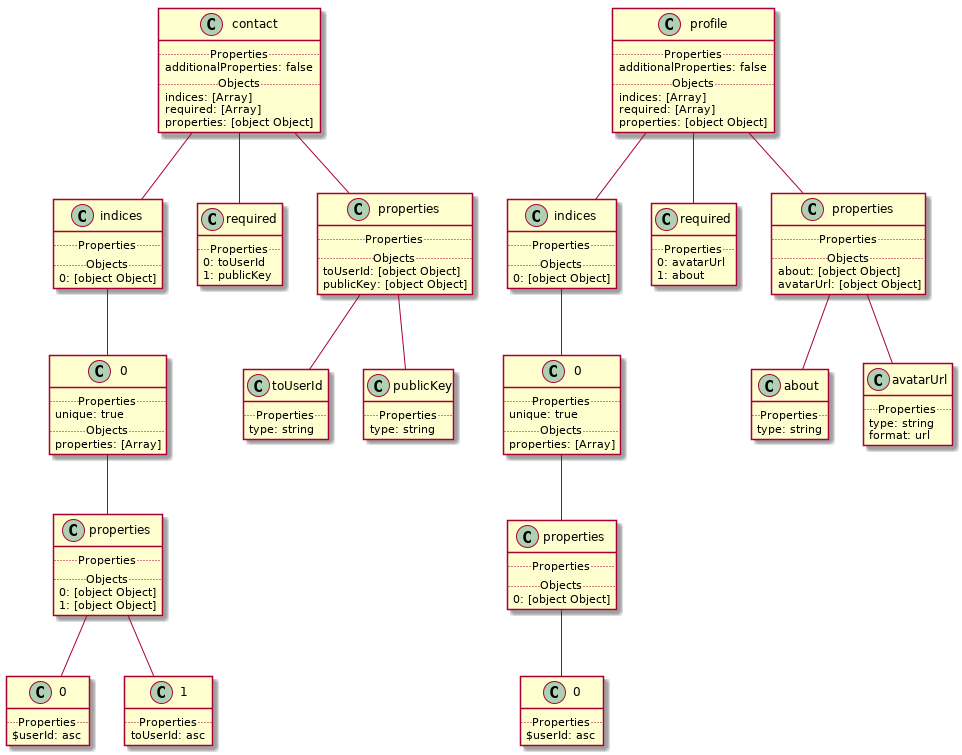
This is a visualization of the JSON data contract as UML class diagram for better understanding of the structure:
Dashpay Contract Diagram#